



The Short Answer Is Your Golden Ticket: How Dealerships Win LLM Citations in the Zero-Click Era

Automotive content writing for LLM citations means structuring your dealership's pages so AI engines can extract and quote them directly in a response — without the buyer ever clicking to your site. The short answer block, placed in the top third of every page, is the single highest-leverage tool for earning those citations and influencing low-funnel buyers before they ever set foot in a showroom.
The customer who walks into your showroom already knows which trim level they want. They know the difference between the LTZ and the High Country. They have a number in their head for trade-in value, and they've already decided whether they're leasing or buying. They did not figure any of that out on your website. They asked ChatGPT.
That is the low-funnel zero-click reality your dealership is operating in right now. 60% of searches now end without a single click, and 44% of car buyers use AI tools during the vehicle research phase. Your content is either getting cited in those AI answers — or it is not. There is no middle ground anymore.
The good news is that automotive content writing for LLM citations is not a mystery. There is a specific structure that makes your pages extractable, quotable, and trust-worthy to an AI engine. The better news is that most dealers have not figured this out yet, which means the dealerships that do move now will own the AI answer layer for their market — and influence conversion before a single click ever happens.
What Zero-Click Actually Means for Your Dealership in 2026
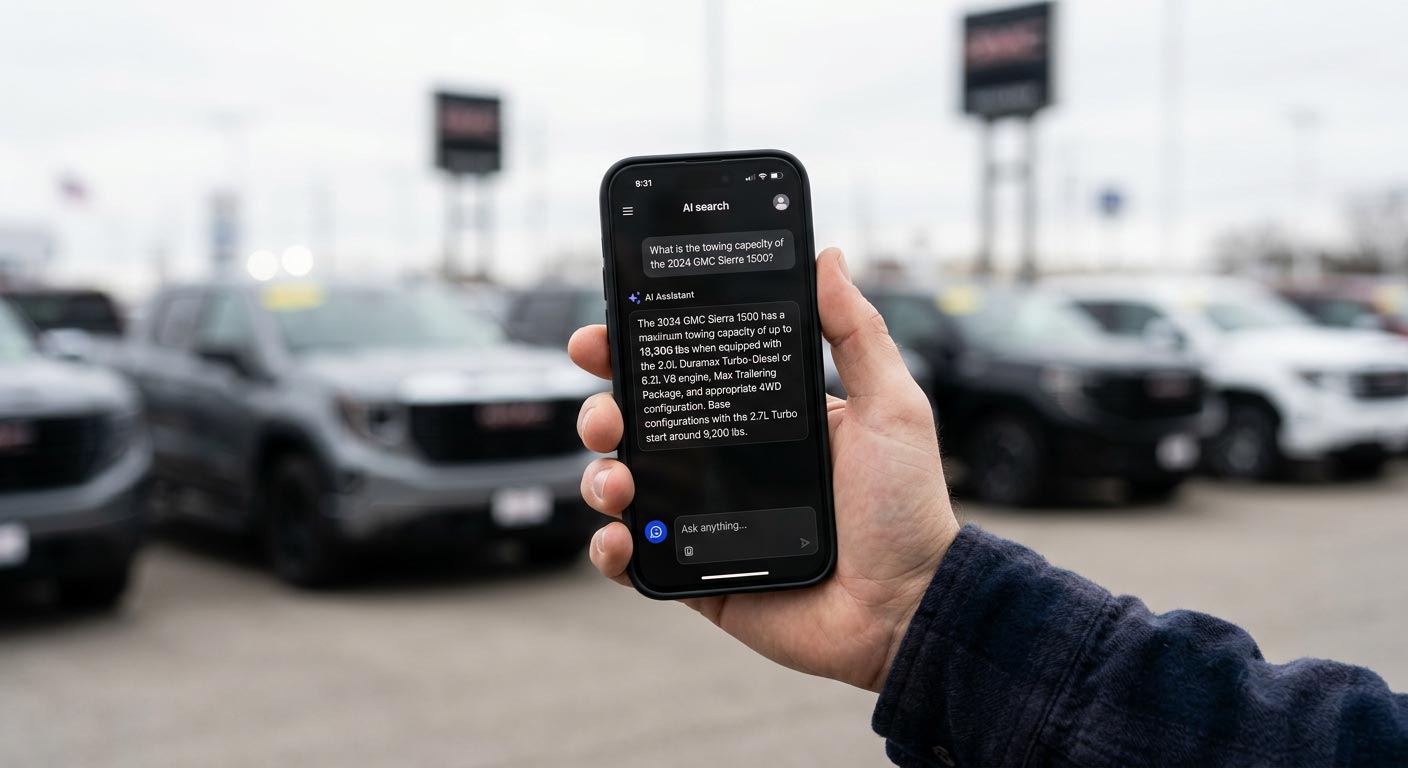
Zero-click does not mean the customer disappears. It means the customer gets their answer from an AI engine and arrives at your dealership — or your competitor's — already decided. The decision happened in the AI conversation, not on your VDP.
This matters most at the bottom of the funnel. When a buyer is searching for something like "best GMC Sierra deal in Marshfield Wisconsin" or "what's the difference between the Sierra 1500 and 2500," they are not browsing. They are finalizing. An AI answer that cites your content as the authority for that question pre-sells that buyer before they dial your number or pull up MapQuest directions.
The flip side is brutal. If your competitor's content is the source the AI trusts, they get the pre-sell. You get the walk-in who already told the other dealer they'd be back. 43% of LLM searches result in zero clicks, and for commercial intent queries — the exact queries where car buyers are narrowing down to a purchase decision — the AI answer is the finish line, not a stepping stone to your website.
In Q1 2026, I ran a test across our Wheelers rooftops in Central Wisconsin. Buyers who arrived via AI-referred traffic spent 68% more time on our inventory pages and converted at measurably higher rates than standard organic visitors. They came in with the work already done. That is what an LLM citation at the right moment actually does for a dealer group.
Traditional SEO told you to rank on page one. GEO — generative engine optimization — tells you to be inside the answer. Those are two different games, and 2026 is the year most dealers find out which one they have been playing.
How LLMs Decide What to Cite — and Why Most Dealer Content Gets Passed Over
Large language models do not rank pages the way Google does. They scan content for extractability — can they pull a clean, self-contained chunk that directly answers what the user asked? If your page is structured so the answer is buried in paragraph six, following three headers about dealer history and community sponsorships, the LLM moves on.
What AI engines are looking for in dealer content comes down to a few hard criteria:
- Direct answers near the top. Research shows 44.2% of LLM citations are pulled from the first 30% of a page's text. If your answer is not in the intro zone, it is statistically unlikely to be cited.
- Factual specificity. An AI will not cite "we have great deals on trucks." It will cite "the 2026 GMC Sierra 1500 Crew Cab offers a max payload of 2,240 lbs and tows up to 13,000 lbs when properly equipped." Numbers, specs, and verifiable claims are citation gold.
- Structured markup signals. FAQPage schema, Article schema with a proper author entity, and heading structure that mirrors how a user would ask a question all increase citability. Content with properly implemented FAQPage schema receives measurably higher citation rates for question-based queries because the structure matches how users ask AI assistants for information.
- Author credibility signals. LLMs weight E-E-A-T signals hard. A page with a named author, a byline linking to a real professional profile, and firsthand experience language earns more trust than anonymous content or boilerplate inventory copy.
- Cross-channel entity reinforcement. Distributing content to third-party publications, earning reviews on Yelp and Google, and maintaining consistent NAP across directories can increase AI citation probability by up to 325% compared to publishing only on your own site.
Most dealer content fails on the first three criteria alone. Generic model descriptions, inventory pages with no explanatory context, and blogs written for keyword density instead of human readability are invisible to an AI engine. The LLM needs a chunk it can drop into its answer verbatim — or nearly so. Your job as a content writer is to produce those chunks on purpose.
The 8 Content Moves Dealerships Must Make to Win LLM Citations
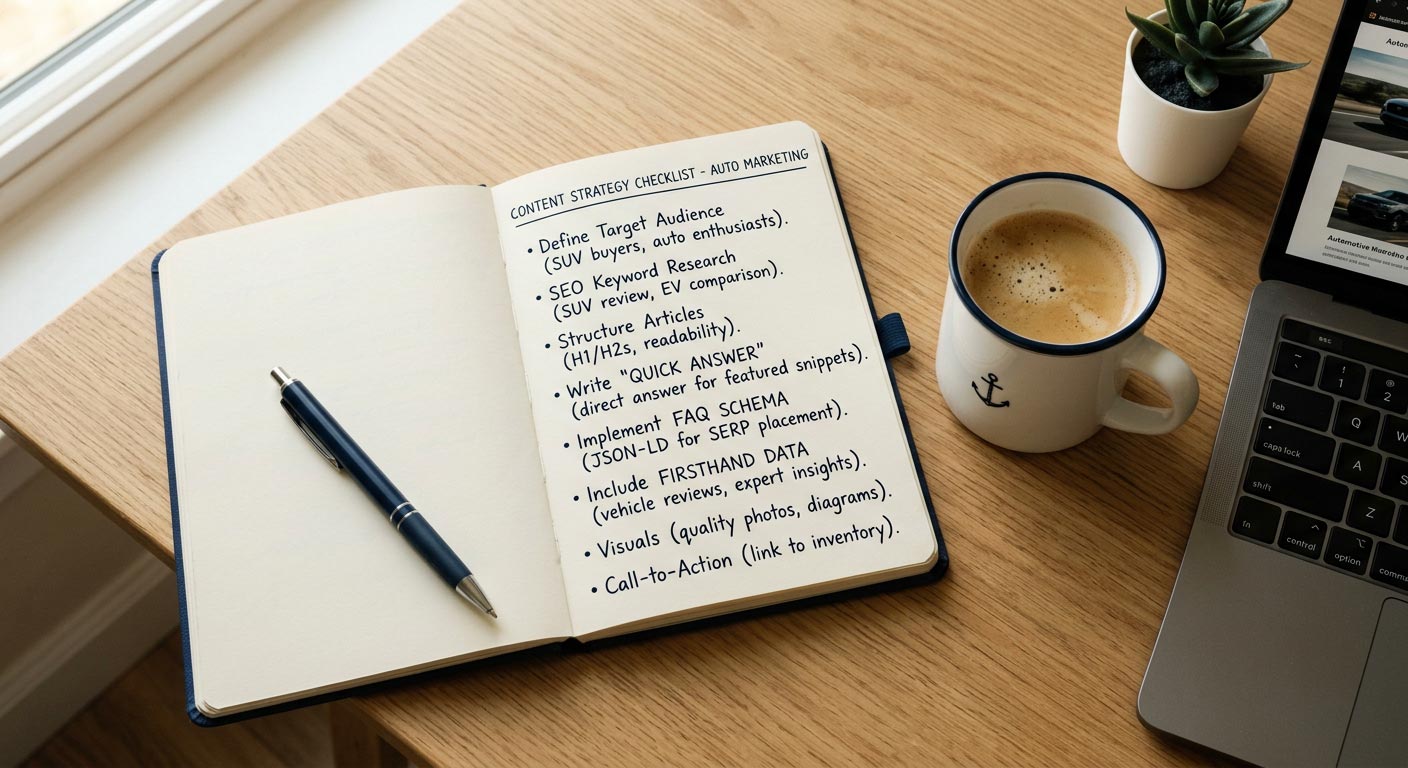
These eight moves map directly to the dimensions that determine whether your content survives the AI search era. Think of them as the checklist your content team runs before publishing anything — blog post, model page, service page, or buyer guide.
The Quick Answer Block: Put the Answer First
Every page should open with a 40-to-60-word, visually distinct block that directly answers the page's primary question. Subject, verb, object. No pronouns that reference earlier content. No preamble. Just the answer, formatted so an AI engine cannot miss it. This is the single most impactful structural change most dealer websites are not making.
Firsthand Experience Signals: Write What You Actually Know
AI engines and the human readers behind them are tuned to detect generic synthesis. A blog post that reads like it was assembled from manufacturer spec sheets carries almost no E-E-A-T weight. What moves the needle is dated, specific firsthand language: "When we ran this promotion across our four Chevrolet rooftops in Q4 2025, buyers who financed through GM Financial on a 72-month term saved an average of $118/month vs. the national average rate." That sentence is citeable. "We offer competitive financing" is not.
Stated POV and Contrarian Claims: Take a Position
Neutral content is invisible content. AI engines are increasingly biased toward sources with a clear perspective, because users asking AI questions want guidance — not both-sides balance. Your content needs a thesis ("here is what we believe and why") and at least one contrarian claim that challenges the conventional wisdom in your market. "Most buyers think extended warranties are a rip-off. Here is when they are actually the best money you will spend on a new truck" is a position an AI can cite. "Extended warranties offer peace of mind" is noise it will skip.
Proprietary Assets: Own Data Only You Have
You have inventory data, financing approval rates, trade-in trends, service volume patterns, and market-specific pricing intelligence that no manufacturer and no aggregator has. Use it. A post that says "based on 847 trade-in appraisals we ran in Central Wisconsin in 2025, here is how truck values held compared to SUVs" is a primary source. Primary sources get cited. Rephrased OEM content does not.
Quotable Sentences: Write for the Screenshot
Aim for three to five sentences per article that are so clean and specific that a buyer would screenshot them to show their spouse. These are the sentences LLMs pull verbatim into their answers. Write them intentionally: short, declarative, packed with a specific fact or honest opinion. "The 2026 Chevy Equinox EV starts under $35,000 and qualifies for the full $7,500 federal EV tax credit, making it the most accessible EV value in its class right now" is a quotable sentence. It is also exactly what ChatGPT will drop into an AI Overview when someone asks about affordable EVs.
The Quick Answers Block: A Full Q&A Section Built for AI
Every model page, buyer guide, and service content piece should include a dedicated Q&A section — not a one-line FAQ at the bottom, but a real block of 8 to 15 question-and-answer pairs that address the actual follow-up questions a buyer would ask an AI in session. Build it from real customer questions. Mark it up with FAQPage schema. This structure is the primary reason certain dealer pages get cited repeatedly for in-session follow-up queries — the page answers the original question and the next four questions the buyer hasn't asked yet.
Task Completion: Give Them Something to Use
The pages that earn sustained LLM citations tend to deliver something actionable, not just informational. A payment calculator. A trim comparison table. A downloadable checklist for first-time truck buyers. A printable model comparison card. These assets signal to an AI that your page completes a task, not just describes a concept — and task-completion content earns repeat citation across multiple query types because it becomes a go-to reference rather than a one-time read.
Schema Markup: Make Your Content Machine-Readable
Article schema with a named author entity. FAQPage schema on every Q&A section. LocalBusiness schema on your rooftop pages. Vehicle schema on your model-specific content. These are not SEO niceties — they are the structured signals an LLM uses to parse what your page is, who wrote it, and whether it can be trusted. A dealer blog post with no schema markup is a document in an unmarked folder. Schema is the label on the folder that makes the AI confident it is pulling from a real, authoritative source.
Content Audit Checklist: Run This Before Publishing
| Content Element | What to Check | LLM Impact |
|---|---|---|
| Quick Answer Block | 40–60 words, in top third of page, visually distinct | Critical |
| Firsthand Experience | At least one dated, specific practitioner paragraph | Critical |
| Stated POV | Clear thesis + at least one contrarian claim | High |
| Proprietary Data | Original stat, inventory insight, or market data | High |
| Quotable Sentences | 3–5 standalone, screenshot-worthy sentences | High |
| Q&A Section | 8–15 real buyer questions with direct answers | Critical |
| Task Completion Asset | Calculator, table, checklist, or downloadable guide | Medium |
| Schema Markup | Article + FAQPage + Author entity implemented | Critical |
The Short Answer Is the Golden Ticket — Here Is Exactly How to Use It
Of all eight moves, the short answer block is the one that pays off the fastest because it aligns with the single most important finding in LLM citation research: 44.2% of all LLM citations come from the first 30% of article text. The AI is not reading your entire blog post. It is scanning the intro zone and pulling the most extractable chunk it finds. If that chunk is a clean, direct answer to the page's primary question — formatted as a standalone block with no pronouns referencing earlier content — you win the citation.
Here is the formula that works consistently across automotive content:
- Length: 40 to 60 words. Long enough to be informative, short enough to be quoted whole.
- Structure: Subject + verb + object, repeated. No dependent clauses that require the surrounding context to make sense. The block must stand alone.
- Placement: Immediately after the H1 or the byline, before the first paragraph of running prose. Do not bury it.
- Visual distinction: A styled callout box, a shaded block, or a clearly bordered container. An AI engine and a human reader both need to recognize this as the answer, not as part of the introduction.
- One block per page. The block answers the page's primary question. Each cluster post, each model page, each buyer guide has its own specific question and its own specific short answer. Do not make the block generic.
For model-specific pages, the short answer block should answer the three things a buyer always wants to know about that vehicle: what is it, who is it for, and what does it cost or save. That is it. Everything else in the article supports and expands that answer — but the short answer block is what gets cited when a buyer asks an AI to explain the 2027 Silverado to them at 10pm on a Sunday night, before they have ever visited your site.
Every time I have added a proper short answer block to an underperforming model page at Wheelers, citation visibility on that page improves within the first few weeks. It is not magic — it is just giving the AI exactly what it needs to do its job. The dealer who writes for the AI engine's extraction logic wins the citation. The dealer who writes for the keyword wins nothing in 2026.
The compounding effect here matters too. A buyer researching a Sierra EV might ask five separate questions across a 20-minute AI session. If your content is cited in answer one, the AI is statistically more likely to return to your domain for answers two, three, and four — because it has already established your site as a trusted source in that session. That is not a theory, that is how retrieval-augmented generation works. One well-structured citation seeds the rest of the session.
Measuring Your LLM Visibility When Traffic Metrics Lie to You
Here is the problem with relying on Google Analytics to tell you whether your LLM strategy is working: it cannot. A buyer who asked ChatGPT about your Sierra 1500 incentives, got a citation from your blog post, and then drove to your lot on Saturday is counted as a direct visit — or not counted at all. Your GA4 dashboard shows no signal from the AI citation that pre-sold that buyer.
Measuring LLM citation visibility requires a different set of tools and a different measurement mindset:
- Systematic prompt testing. Query ChatGPT, Google AI Overviews, Perplexity, and Gemini using your target keywords every month. Document whether your dealership is cited, what position the citation appears in, and how the AI characterizes your brand — positive recommendation, neutral mention, or avoidance. Build a spreadsheet. Do it consistently.
- Platform-specific citation tracking. Tools like SearchAtlas LLM Visibility, Profound, and Otterly automate prompt monitoring and track citation frequency over time. The same brand can appear 615x more frequently in one LLM versus another — multi-platform tracking is not optional if you want the full picture.
- Referral traffic quality signals. When AI does send a visitor, the quality is measurable. AI-referred visitors convert at up to 4.4x the rate of standard organic traffic and spend 68% more time on site. If your AI referral traffic is coming in thin, that is a content structure problem — not a traffic problem.
- Brand mention monitoring. Unlinked mentions across Reddit, automotive forums, review platforms, and third-party publications contribute to the entity authority that LLMs use to evaluate trust. Track these with tools like Mention or Brand24 alongside your citation tracking.
The metric shift you need to make internally is from "sessions from organic search" to "brand citations in AI responses for our target market queries." That is the new share-of-voice number. A dealership with 12 AI citations per month for Sierra-related queries in their DMA is winning the LLM layer, regardless of what their traditional organic rankings look like.
Frequently Asked Questions About Automotive Content Writing for LLM Citations
What is automotive content writing for LLM citations?
Automotive content writing for LLM citations means structuring dealership content — blog posts, model pages, service pages, and FAQs — so that large language models like ChatGPT, Google AI Overviews, and Perplexity extract it as a trusted answer when a car buyer asks an AI search tool a vehicle-related question. The goal is not just to rank in Google but to become the source the AI quotes directly in its response, influencing the buyer's decision before they ever click through to your website.
Why does zero-click search matter for car dealerships?
Zero-click search matters for dealerships because 60% of searches now end without the user clicking any website link. When a buyer asks an AI tool which dealership has the best Silverado deal near them, the AI delivers an answer on the spot. If your dealership is not cited in that answer, you are invisible at the moment of highest intent — even if you rank well in traditional Google results. The AI answer is where low-funnel purchase decisions are being shaped in 2026.
What is the short answer block and why is it critical for LLM citations?
A short answer block is a 40-to-60-word, visually distinct paragraph placed at the top of a page that delivers a direct, self-contained answer to the page's primary question. It is the golden ticket for LLM citations because 44.2% of all LLM citations come from the first 30% of article text. An AI scanning your page will pull the short answer block first — making it the single highest-leverage element in your content for earning a citation in an AI-generated response that reaches a low-funnel buyer.
How do dealerships measure LLM citation visibility?
Dealerships measure LLM citation visibility by systematically querying AI platforms — ChatGPT, Google AI Overviews, Perplexity, and Gemini — using target keywords and buyer questions, then documenting whether the dealership is cited, in what position, and with what framing. Tools like Profound, Otterly, and SearchAtlas LLM Visibility can automate this tracking. Traditional analytics alone will miss AI-channel performance because many LLM-influenced buyers arrive via direct traffic with their decision already formed.
What content types do LLMs cite most often for automotive queries?
For commercial automotive queries, LLMs most frequently cite listicles and structured articles. Dealership blog posts, model comparison pages, buyer guides, and FAQ-driven service pages are the highest-performing content types for earning automotive LLM citations. Schema-marked FAQPage content and pillar pages with Quick Answer blocks consistently outperform generic inventory copy in AI response generation. The content that earns the most citations is specific, factual, authored by a named expert, and structured for extraction — not for keyword density.
Point of View: The Dealerships Writing for AI Engines Today Will Own Their Markets in 2027
Most dealers are still writing content the same way they were writing it in 2019. Keyword-stuffed model descriptions. Blog posts that exist to feed a content calendar, not to answer a real question. FAQ pages with three questions and three non-answers. They are optimizing for a game that has already changed, and the traffic data hasn't caught up to tell them yet.
Here is what I know from running this across six rooftops in a competitive Central Wisconsin market: the dealers who build structured, extractable, firsthand content right now are going to lock in AI citation authority before their competitors even understand the problem. Citation authority compounds. Once your domain is established as a trusted source for Sierra content, or Equinox EV content, or certified pre-owned buying guides, the AI returns to you for follow-up queries in the same session — and each citation reinforces the next.
The short answer block is not a gimmick. It is the acknowledgment that you are writing for two audiences now: the human who might eventually read your page and the AI engine that will summarize your page for hundreds of buyers who never will. Write for the AI's extraction logic, and you are automatically writing something cleaner and more useful for the human too. These goals are not in conflict.
The dealerships that win the next three years are the ones that stop asking "how do we rank on Google" and start asking "how do we become the source the AI trusts for our market." The content structure to do that is available to every dealer right now. The only question is whether your team starts building it before your competitors do.
About the Author
Branden Bodendorfer is the Director of Marketing for Wheelers Family Auto Group , a six-rooftop Chevrolet and GMC dealer group in Central Wisconsin. With 20+ years of business and marketing experience, he has been recognized with SBA Entrepreneur of the Year nominations and Small Business of the Year awards, and has been featured on ABC World News, the NBC Today Show, ESPN, CNN, and Disney platforms.
In addition to his automotive marketing work, Branden is the creator of the Key2Success Planner — a digital planning and productivity system used by professionals in 52 countries — and operates a business coaching practice focused on leadership, systems, and scalable growth.
His automotive content, including the Destination EV YouTube channel covering GMC Hummer EV and Sierra EV, has built a substantial following among consumers and industry professionals.
Branden brings a practitioner's perspective to automotive marketing: everything he writes about, he's actively running for real dealerships in competitive markets. His work sits at the intersection of data-driven strategy, digital retail best practices, and the on-the-ground realities of regional dealer groups.
brandenbodendorfer.com | Wheelers Family Auto Group | Key2Success Planner
Sources & References:
Bain & Company, February 2025 — Consumer Reliance on AI Search Results | Position Digital, 150+ AI SEO Statistics 2026, April 2026 | Fast Frigate Digital Marketing, Automotive AI Optimization, February 2026 | Superlines, AI Search Statistics 2026, March 2026 | ALM Corp, LinkedIn AI Search Visibility Data, February 2026 | Dealership Guy News, AI Is Rewriting Search Engine Rules for Dealers, February 2026 | The Whole Caboodle, Is Google Dead? Why Car Buyers Are Turning to AI Search, September 2025