



Search Console Platform Properties: Google's New Signal That Dealerships Can't Keep Faking It
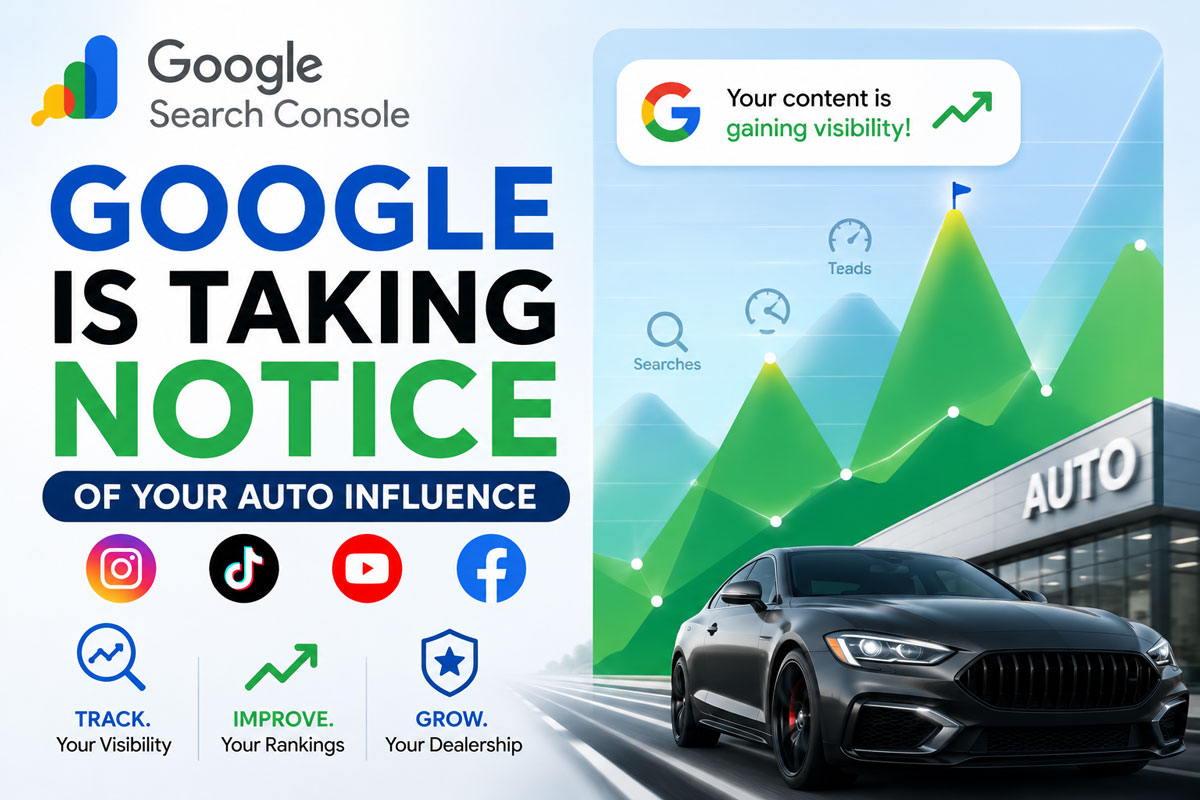
On July 7, 2026, Google rolled out a new Search Console property type called platform properties. For the first time, Search Console platform properties let you see how your Instagram, TikTok, X, and YouTube posts actually perform in Google Search and Discover, sitting right next to your website data in the same dashboard. Most dealer marketers will file this under "new report, cool, moving on."
That read misses the point. Google didn't build this so you could admire a chart. It built it because firsthand content, the stuff real people make and share, is becoming the content Google trusts most. And most dealership marketing has almost none of it.
This is both a green light and a warning shot. The green light: there's finally a way to measure how your social and video content shows up in Search. The warning: Google is telling you, plainly, what kind of content it wants to surface next. Below is what the feature does, why it matters for a dealer group, how to turn it on, and the checklist we use to make content that actually earns a citation instead of getting summarized and forgotten.
Search Console platform properties are a new Google Search Console property type, launched July 7, 2026, that show how your Instagram, TikTok, X, and YouTube content performs in Google Search and Discover. For dealers, they're a signal: Google is now measuring firsthand social and video content, and it's ready to reward the stores that make it.
What Search Console platform properties actually do
A platform property is a new kind of Search Console property that sits alongside the domain and URL properties you already use. You connect an Instagram, TikTok, X, or YouTube account, verify it, and Google starts reporting how that account and its individual posts show up in Search and Discover. Announced by Search Console product lead Moshe Samet on the Google Search Central blog, the feature gives each connected account three familiar reports.
The Performance report shows clicks, impressions, average click-through rate, and average position, and it lets you filter and sort by post to see exactly which content and which queries drive traffic. You can export the data if you'd rather crunch it elsewhere. The Insights report gives a higher-level view: recent traffic trends, your top posts, and how people are finding your account on Google. Achievements tracks milestones, like passing a new click threshold in a rolling 28-day window, per reporting from Semrush.
A few details matter for planning. It works even if you don't own a website, which is new territory for a tool that used to be locked to verified site owners. There's no historical backfill, so your data starts the day you verify. It can take up to 48 hours for numbers to show up, and Google is rolling the feature out gradually, so it may not be in your account yet. Don't confuse it with Search profiles, the public creator pages Google launched in June 2026. Platform properties are private analytics for you. Search profiles are public pages for your audience.
Why this should worry dealers running the 2010s playbook
Look at how most dealership marketing budgets actually get spent. Display ads. Retargeting. Vehicle listing ads. Expensive direct mail. Heavy OTT and broadcast. It's a spend-heavy loop built to interrupt people until one of them raises a hand. And most dealership websites are three things and three things only: inventory search, generic OEM model pages, and a lead form.
What's missing from almost all of it? A real person. Firsthand content is rare at the store level, influencer-style content feels off-brand to most dealers, and most OEMs aren't leaning on real creators either. So the whole category ends up sounding the same, saying the same OEM lines, chasing the same clicks.
Here's the contrarian part. Reddit has been getting cited all over the search results for a couple of years now, and that's not an accident. It's Google's way of pulling in real human feedback: how a product actually works, how it holds up, how it stacks up against the alternative. That's the signal Google keeps reaching for. Platform properties are the same move, one layer out. Google is now measuring the firsthand social and video content it wants to reward. The dealers who win the next few years aren't the ones making one more funny Reel. They're the ones treating experience, expertise, authority, and trust as the actual product. Some of the sharpest ideas here don't come from inside the car business at all, which is a case I made in why the best automotive marketing ideas aren't coming from automotive.
At Wheelers, that's the whole content model. We don't publish faceless posts. We put real people, real trucks, and real answers on the page, and we build E-E-A-T into it on purpose. It's slower than buying another display flight. It also compounds, which display never does.
The authority moat: national ranking is a local weapon
Building authority online builds a moat around your store. That sounds abstract until you watch it work. When we published our firsthand coverage of the 2027 Chevrolet Silverado release, that article got cited above the OEM and above national news outlets, and it ranked globally. A six-rooftop Chevy and GMC group in central Wisconsin, outranking Chevrolet on Chevrolet's own truck. You can read our 2027 Silverado breakdown here.
Getting ranked nationally might not feel like a dealer win. Nobody in Marshfield is buying a truck because a search result showed up in another time zone. But think about what that authority does back home. Say your past customer, call her Susie Car Buyer, types "which Tahoe trim level fits my lifestyle" into Google a year after her last purchase. A store that Google already trusts as a real, experienced source is the store that shows up for her, in a full-size SUV research moment, right when she's deciding. National authority is what makes the local moment go your way.
That's the trade most dealers miss. You're not chasing readers in Phoenix. You're teaching Google that your store is a real authority on the vehicles you sell, so that when a local buyer asks a real question, you're the answer. The reach is national. The payoff is your zip code.
How to set up Search Console platform properties
Setup takes about two minutes per account, and there's no reason to wait, because there's no backfill. Every day you don't connect is a day of data you'll never get back. Here's the flow, drawn from Google's own steps and confirmed by early hands-on reports from Search Engine Land.
| Step | What to do | Priority |
|---|---|---|
| 1. Open Search Console | Go to the verification page, or open the property selector dropdown anywhere in Search Console and click "Add property." | Do now |
| 2. Pick a platform | Choose one of the four: Instagram, TikTok, X, or YouTube. If you don't see the option yet, the rollout hasn't reached your account. Check back. | Do now |
| 3. Verify ownership | Follow the on-screen prompts to authorize the connection to your account. Do this yourself in the platform's login. Never hand account credentials to a vendor for this. | Do now |
| 4. Repeat per account | Add a property for each platform your store actually posts on. Each one reports separately. | Same day |
| 5. Wait for data | Give it up to 48 hours before numbers appear. The default reporting window is 28 days, same as the rest of Search Console. | Within 2 days |
| 6. Read the three reports | Check Performance for winning posts and queries, Insights for trends and discovery, Achievements for milestones. Export what your team needs. | Weekly |
One practical note for multi-rooftop groups. Connect the accounts you truly run, then let the data sit for a few weeks before you draw conclusions. A single week of a brand-new report isn't a strategy. It's a baseline. Build the record first, then act on it.
Make the content worth finding: the 9-point checklist
The new report tells you what's getting found. It doesn't make anything worth finding. That part is on you. This is the 9-point checklist we run every post, video, and article against before it goes out, the same framework behind our AI search content audits. It's built for the way people search now, in full questions instead of two-word keywords, and for the way AI answers pull from real sources.
| Checkpoint | What it means for your content | Priority |
|---|---|---|
| 1. Quick answer | A 40 to 60 word direct answer near the top, in plain language, before any buildup. | Critical |
| 2. Firsthand experience | A dated, specific detail from your actual work: a test drive, a real customer question, a service-bay pattern. This is the moat AI can't fake. | Critical |
| 3. Stated POV | A clear thesis and at least one claim that pushes against the easy, both-sides answer. | High |
| 4. Proprietary asset | Something AI can't pull from public sources: your own photo, your own screenshot, your own number, your own framework. | Critical |
| 5. Quotable sentences | Three or more standalone lines a person could screenshot and share, with your name attached to the claim. | High |
| 6. Common questions block | 8 to 15 short question-and-answer pairs covering the follow-ups a buyer asks in the same session: budget, timing, trims, alternatives. | High |
| 7. Task completion | A real deliverable, not just a call to a salesperson: a checklist, a comparison, a calculator, a trim guide they can act on. | Medium |
| 8. Schema | Specific schema type (not generic Article), an author with a sameAs list, mentions and about properties, and a publisher logo. | High |
| 9. Conversational query match | Your headline and opening answer a full, real-world question with several conditions, not a bare two-word keyword. | Medium |
Score every piece Pass, Partial, or Fail on all nine. Fix the Fails first, because a missing quick answer or generic schema is what keeps you out of the citation slot entirely. Firsthand experience and a proprietary asset are the two that matter most over time, since those are the exact things a language model can't reproduce from public pages. Do this on your social and video content, not just your blog, because platform properties just made that content measurable too.
FAQ about Search Console platform properties
What are Search Console platform properties?
Platform properties are a Google Search Console property type launched July 7, 2026 that show how your Instagram, TikTok, X, and YouTube content performs in Google Search and Discover, using the same clicks, impressions, and query data Search Console already reports for websites.
Which platforms do Search Console platform properties support?
At launch, four: Instagram, TikTok, X, and YouTube. Google has said it is rolling the feature out gradually over several weeks, so the option may not appear in every account right away.
Do I need a website to use platform properties?
No. Platform properties work for creators and brands who publish on social and video platforms even if they have no website of their own. That is a real shift, because Search Console used to be limited to verified site owners.
Does Search Console show historical data for social content?
No. There is no backfill. Your performance history starts the day you verify the property, and it can take up to 48 hours for data to appear. That is why setting it up now matters, so you start building a record you can learn from.
How are platform properties different from Search profiles?
Search profiles, launched in June 2026, are public pages that pull a creator's content together for their audience. Platform properties are the opposite: private analytics, visible only to you, that measure how your content performs in Google Search. Setting up one has no effect on the other.
Point of View: Google Just Handed You the Playbook
Every so often Google stops hinting and just tells you what it wants. This is one of those times. It spent years pulling Reddit into the results because it wanted real human input. Then it added a whole property type to measure firsthand social and video content. Read that in order and the message is hard to miss.
The dealers who lose the next few years won't lose because they spent too little on display or mailed too few postcards. They'll lose because they never put a real person on the page. AI can rewrite an OEM spec sheet in a second. It cannot go drive the truck, sit with the customer, or tell you what actually broke in the service bay. That's your unfair advantage, and it's the one thing the whole category keeps skipping.
Authority isn't a vanity metric. It's the moat. When we ranked above Chevrolet on the 2027 Silverado, the point was never the national reach. The point was that Google now treats our stores as a trusted source, and that trust cashes out locally, on the exact search a real buyer makes before they walk in.
So here's the job. Google is giving you a scoreboard for firsthand content and a clear reason to make more of it. Your move is to turn on platform properties this week, then start putting real experience on every page, post, and video you publish. The stores that do this will quietly own their market. The ones stuck in the old loop will keep paying to interrupt people who already stopped listening.
About the Author
Branden Bodendorfer is the Director of Marketing for Wheelers Family Auto Group , a six-rooftop Chevrolet and GMC dealer group in Central Wisconsin. With 20+ years of business and marketing experience, he has been recognized with SBA Entrepreneur of the Year nominations and Small Business of the Year awards, and has been featured on ABC World News, the NBC Today Show, ESPN, CNN, and Disney platforms.
In addition to his automotive marketing work, Branden is the creator of the Key2Success Planner, a digital planning and productivity system used by professionals in 52 countries, and operates a business coaching practice focused on leadership, systems, and scalable growth.
His automotive content, including the Destination EV YouTube channel covering the GMC Hummer EV and Sierra EV, has built a substantial following among consumers and industry professionals.
Branden brings a practitioner's perspective to automotive marketing: everything he writes about, he's actively running for real dealerships in competitive markets. His work sits at the intersection of data-driven strategy, digital retail best practices, and the on-the-ground realities of regional dealer groups.
brandenbodendorfer.com | Wheelers Family Auto Group | Key2Success Planner
Sources & References:
Google Search Central Blog, July 2026 | Search Engine Land, July 2026 | Search Engine Journal, July 2026 | Semrush, July 2026